↓
 

Dothan Land Surveying

Your local licensed surveying firm.

Dothan Land Surveying
  • Home
  • Services
  • ALTA Title Survey
  • Boundary Surveying
  • Construction Survey
  • Drone LiDAR Mapping
  • Flood Survey | Elevation Certificate
  • Land Surveying
  • Lot Survey
  • Topographic Survey
  • About Us
  • Blog
  • Contact Us
Home - Page 2 << 1 2 3 4 … 9 10 >>

Post navigation

← Older posts
Newer posts →

Why Hilly Subdivision Developers Order a Topographic Survey First

Dothan Land Surveying Posted on May 20, 2026 by Dothan SurveyorMay 21, 2026

Hilly subdivisions look clean on a site plan. Then the bids come in. Retaining walls cost more than most developers expect. Grading surprises can blow a budget wide open. A topographic survey done early catches those surprises before they turn into change orders.

What Is a Topographic Survey?

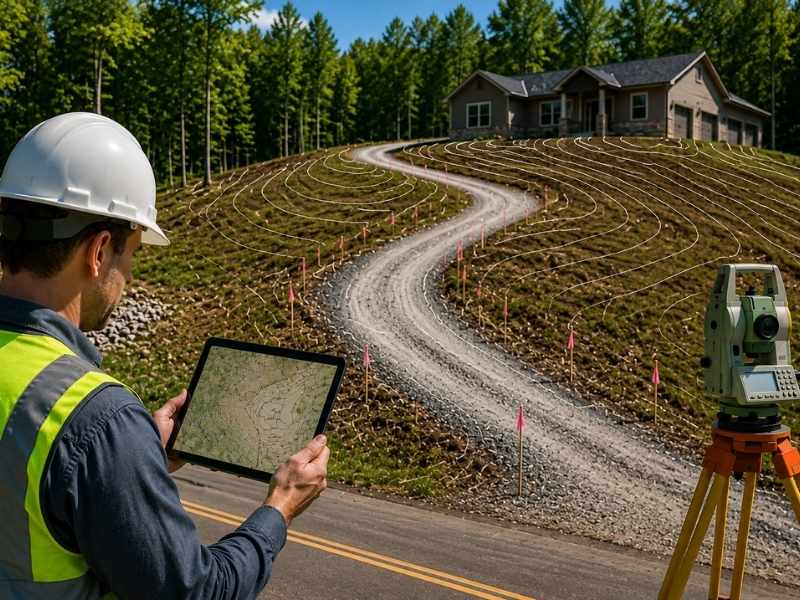
A topographic survey maps a land’s surface. It records elevation changes, slopes and existing features like trees, drainage paths and structures. Surveyors collect thousands of data points across the site. The result is a contour map that shows exactly how the ground rises and falls.

This isn’t the same as a boundary survey. A boundary survey tells you where your property lines are. A topographic survey tells you what’s happening inside those lines, elevation-wise.

Why Hilly Sites Need More Than a Boundary Survey

Flat lots are forgiving. Hilly lots aren’t.

A 10-foot elevation change across a 60-foot lot changes everything: wall heights, drainage design, cut-and-fill ratios and foundation types. Without elevation data, engineers are guessing. Guessing costs money.

Retaining wall design depends on knowing exactly how steep each slope is. A wall holding back 4 feet of soil is a very different structure than one holding back 12 feet. The topographic survey gives engineers the numbers they need to design walls that won’t fail.

How Topographic Data Drives Grading Plans

Cut and Fill Calculations

Grading is moving dirt. Cut means removing soil. Fill means adding it. The goal is to balance the two so you’re not hauling material off-site or trucking it in. Both are expensive.

A topographic survey lets the civil engineer calculate cut-and-fill volumes before anyone touches the ground. On a hilly site, this math matters a lot. Getting it wrong means surprise costs in the six figures.

Drainage Design

Water follows elevation. On a hilly site, water can collect in low spots, erode slopes or flood finished lots if drainage isn’t designed right. Before design starts, check your parcel against the FEMA Flood Map Service Center to confirm flood zone status and any drainage overlay requirements.

The topographic map shows where water will naturally flow. Engineers use that data to place storm drains, swales and retention areas in the right spots. Without it, drainage is a guessing game. Bad drainage on a hilly site is an expensive fix.

Spotting Problem Areas Early

Some spots on a hilly site are just harder to build on. Steep slopes may need deep cuts. Soft soils in low areas may need special foundations. Rock close to the surface can make grading extremely slow and costly.

A topographic survey won’t reveal soil conditions on its own. But it flags areas worth investigating further. Pair it with a geotechnical report and you have a clear picture of what you’re working with.

Retaining Walls: The Hidden Cost in Hilly Subdivisions

Retaining walls are often the biggest surprise in a hilly subdivision budget.

Early project estimates sometimes use a rough cost-per-lot figure. That figure doesn’t account for a site where half the lots need 8-foot walls and the other half need none. The topographic survey separates those lots before budgets are locked in.

Wall Heights and What They Mean for Your Budget

  • Walls under 4 feet: Usually simple. Gravity or timber walls work fine.
  • Walls from 4 to 8 feet: These need engineering. Concrete blocks or poured concrete are common solutions.
  • Walls over 8 feet: Full engineered design required. These are expensive. They also need permits and inspections in most jurisdictions.

The topographic survey tells you which lots need which walls. That information feeds directly into the grading plan and the project budget.

Tiered Wall Systems

On steep lots, one tall wall isn’t always the right answer. Tiered walls, smaller walls stacked with a flat bench between them, are often cheaper and easier to permit. Designing a tiered system requires exact elevation data. The topographic survey provides it.

When to Order the Survey

Before design. Before engineering. Before you submit anything to the city or county.

Get the topographic survey done as part of due diligence. Use it to confirm the site can support the subdivision you’re planning. If grading costs are too high, you want to know before you close on the land, not after.

Some developers skip this step to save a few thousand dollars upfront. Then they spend tens of thousands dealing with grading surprises during construction. The math doesn’t work.

What the Survey Report Includes

A standard topographic survey for a subdivision site typically includes:

  • Contour lines at 1-foot or 2-foot intervals
  • Spot elevations at key points across the site
  • Locations of drainage features and flow paths
  • Existing structures and utilities (if present)
  • Tree locations and sizes
  • Benchmarks tied to a known elevation reference

The civil engineer uses this to build the grading and drainage plan. The structural engineer uses it to design retaining walls. Your cost estimator uses it to build a realistic budget.

Frequently Asked Questions

How accurate is a topographic survey? 

Modern surveys use GPS and total station equipment. Vertical accuracy is typically within 0.1 feet. For grading and retaining wall design, that’s plenty of precision.

How long does a topographic survey take? 

For a typical subdivision site of 5 to 20 acres, field work takes one to three days. Processing and delivering the final map usually adds one to two weeks.

Does a topographic survey replace a geotechnical report? 

No. A topographic survey maps the surface. A geotechnical report analyzes what’s below it: soil type, bearing capacity and rock depth. You’ll likely need both for a hilly subdivision.

Can drone or aerial data replace a traditional survey? 

Drone-based surveys are faster and work well for large sites. For final engineering and permitting, many jurisdictions still require ground-control points tied to a licensed surveyor. Check with your local authority before assuming drone data alone is enough.

What does a topographic survey cost for a subdivision site? 

Costs vary by site size, terrain and location. A 10-acre hilly site typically runs between $3,000 and $8,000. That’s a small cost compared to what it prevents in grading and wall budget surprises.

Posted in land surveyor | Tagged Topographic survey

Why Every Commercial Buyer Needs an ALTA Survey

Dothan Land Surveying Posted on May 19, 2026 by Dothan SurveyorMay 21, 2026
Surveyor performing an alta survey at a commercial construction site with cranes and active development in the background

You found the right commercial property. The price works. The deal looks clean.

Before you sign anything, ask one question: has an ALTA survey been completed?

If the answer is no, stop.

An ALTA survey is one of the most important steps in a commercial real estate deal. Skip it and you’re taking on risks that could wreck the entire investment. This article breaks down what it covers, why lenders require it, and what you’re walking into without one.

What Is an ALTA Survey?

An ALTA survey is a detailed property survey. It follows standards set by two national organizations:

  • The American Land Title Association (ALTA)
  • The National Society of Professional Surveyors (NSPS)

These standards keep surveys consistent across the country. Every licensed surveyor follows the same rules. That’s why lenders and title companies trust the results.

What It Shows

  • Exact property boundaries
  • All buildings and improvements on the land
  • Easements and rights-of-way
  • Encroachments from neighboring properties
  • Flood zone classification
  • Utility lines and access points
  • Zoning information

A boundary survey shows where the lines are. An ALTA survey shows everything that could affect how you use the land. A boundary survey doesn’t come close.

Why Lenders Require It

Most commercial lenders won’t fund a deal without an ALTA survey.

That’s not a suggestion. It’s a condition of the loan.

Lenders are putting money into the property too. If an easement cuts through your planned building site, that’s their problem as much as yours. If a neighbor’s structure sits inside the property line, it affects the value of their collateral.

An ALTA survey removes the guesswork. Lenders approve loans faster when they can see exactly what they’re funding.

What an ALTA Survey Can Uncover

This is where the survey earns its cost. Here are real issues it finds:

Encroachments

A neighboring building, fence or driveway may cross into your property. A title search won’t catch this. A surveyor will.

Hidden Easements

Easements give others legal access to part of your land. Utility companies, governments or private parties may have rights you don’t know about. Some are buried in old records. An ALTA survey pulls them out.

Access Problems

Can you legally reach the property from a public road? Some parcels rely on private access agreements. If that agreement ends, you may have no legal way in or out.

Flood Zone Status

An ALTA survey confirms whether the property sits inside a flood zone. This affects insurance costs and what you can build on the site.

Zoning Conflicts

The property’s current use may not match its zoning. An ALTA survey catches this before money changes hands.

What Happens If You Skip It?

Skipping an ALTA survey feels like saving money. It’s not.

Here’s what buyers have run into after closing without one:

  • An easement ran straight through the planned parking lot
  • A neighboring building encroached two feet inside the property line
  • There was no legal road access. Just a verbal handshake agreement
  • Zoning restrictions killed the entire development plan

Each of these is expensive after closing. Some can’t be fixed at all.

The survey costs a fraction of what any one of these problems costs to resolve.

Land surveyor conducting an alta survey with GPS equipment near a commercial property and roadway project.

ALTA Survey vs. Other Survey Types

A boundary survey only shows property lines. It’s built for residential lots. A topographic survey maps elevation and terrain. Builders use it for site grading and planning. An ALTA survey covers all of that plus easements, encroachments, utilities and flood zones.

For commercial real estate, there’s no substitute for it.

How Long Does It Take?

Most ALTA surveys take 2 to 4 weeks. Larger or more complex properties take longer.

Order it early. Don’t wait until the last week of your due diligence period.

Common causes of delays:

  • Hard-to-find historical survey records
  • Properties with multiple parcels or irregular boundaries
  • Unresolved title issues
  • Limited access to the site

A rushed survey misses things. Build the timeline accordingly.

How Much Does an ALTA Survey Cost?

Cost depends on a few things:

  • Size of the property
  • Complexity of the boundaries
  • Terrain and site conditions
  • Number of structures on the land

Most commercial ALTA surveys run between $2,000 and $8,000. Larger parcels cost more.

Compare that to the cost of a boundary dispute. Or a failed building permit. Or a legal fight over access rights.

The math isn’t complicated.

5 Frequently Asked Questions About ALTA Surveys

Is an ALTA survey required for all commercial purchases? 

Not always required by law. But most commercial lenders and title companies require one before closing. Don’t assume you can skip it.

Who pays for the ALTA survey?

Usually the buyer. Sometimes it gets negotiated into the purchase agreement. Work this out early in the deal.

Can I use an old ALTA survey from a previous owner? 

Sometimes. Lenders may accept a recent survey if it meets current ALTA/NSPS standards and nothing on the property has changed. Always confirm with your lender first.

What’s the difference between an ALTA survey and a title search? 

A title search reviews public records for ownership history and liens. An ALTA survey physically measures the land and everything on it. You need both.

How do I find the right surveyor for an ALTA survey? 

Look for a licensed land surveyor with commercial experience. Ask if they follow the current ALTA/NSPS Minimum Standard Detail Requirements, last updated in 2021.

Posted in land surveyor | Tagged ALTA survey

Why Homeowners Should Check Elevation Certificates Before Storm Season

Dothan Land Surveying Posted on May 15, 2026 by Dothan SurveyorMay 14, 2026
Homeowner reviewing an elevation certificate outside a residential property before storm season

What an Elevation Certificate Tells You About Flood Risk

An elevation certificate shows how high a home sits compared to the expected flood level in the area. Insurance companies, lenders, and local offices use this document to review flood risk, insurance rates, and some building permits.

Many homeowners never look at this paperwork until heavy rain causes a problem. That delay can lead to higher insurance costs, confusion during home sales, or flood damage that catches people off guard.

Storm season puts extra pressure on homes and drainage systems. A current elevation certificate helps homeowners understand possible flood risks before severe weather arrives.

Storm season can create problems fast. Heavy rain can flood streets, yards, garages, and homes within hours. Many people think flood damage only happens near beaches or large rivers. That belief causes trouble every year.

Flooding can happen in almost any neighborhood after a strong storm.

Water moves quickly during heavy rain. Ditches overflow. Storm drains back up. Low spots in a yard may start holding water for days. Some homeowners do not notice drainage problems until they see water moving toward the house.

That is why elevation certificates matter before storm season starts.

What Is an Elevation Certificate?

An elevation certificate is a document based on property elevation measurements. It shows how the structure compares to the local flood level used by FEMA and flood insurance companies.

The certificate may include:

  • The property flood zone
  • The elevation of the home
  • Lowest floor height
  • Garage elevation
  • Utility equipment elevation
  • FEMA flood map details

These measurements help determine flood insurance costs.

Even a small change in elevation can affect insurance rates. Some homeowners pay more than necessary because their records are outdated. Others discover they may qualify for lower flood insurance costs after getting updated elevation data.

Why Storm Season Brings More Attention to Elevation Problems

Small drainage issues often stay hidden during dry weather. Heavy rain changes everything.

After a storm, homeowners may notice:

  • Water collecting near the foundation
  • Flooded driveways
  • Wet crawl spaces
  • Standing water in the yard
  • Water flowing toward the house

These problems often connect to elevation or drainage conditions on the property.

Flood maps can also change over time. New construction nearby may affect drainage patterns too. Roads, parking lots, and new neighborhoods can change how water moves through an area after heavy rain.

A property that looked safe years ago may face different flood conditions today.

Why Insurance Companies Want Accurate Elevation Data

Flood insurance companies rely on elevation information when they estimate flood risk.

If the records are outdated or inaccurate, homeowners may pay higher premiums. Some people do not realize this until they review their elevation certificate years later.

Others find out during policy renewals.

That creates stress during storm season because survey companies often receive more requests after major storms move through an area.

Checking elevation records early gives homeowners more time to handle updates before bad weather arrives.

An Elevation Certificate Can Help During a Home Sale

Aerial view of residential flood zones and property elevations used for elevation certificate reviews

Flood questions can delay a home sale very quickly.

Buyers want clear answers about flood risk. Lenders often request flood documents before approving financing. Insurance companies may also ask for elevation information before issuing coverage.

Without a current elevation certificate, delays can happen.

Some buyers become nervous when flood information looks incomplete. Others worry about future insurance costs. This happens more often after large storms because buyers pay closer attention to flood issues.

A current elevation certificate can help remove confusion during the buying and selling process.

Older Elevation Certificates May No Longer Match Current Conditions

Many homeowners assume an old elevation certificate stays accurate forever. That assumption causes problems.

Flood zones can change over time. Nearby grading work may change drainage patterns. New development in the area can also affect how water moves during storms.

An older certificate may no longer reflect current conditions on the property.

That is one reason many homeowners review their elevation records before storm season starts.

A licensed surveyor can help determine whether the existing certificate still matches the property accurately.

Small Elevation Differences Can Create Expensive Repairs

Many people picture flooding as several feet of water inside the home. Real flood damage often starts much earlier.

Water entering a garage or crawl space can still create major repair costs. HVAC systems, electrical equipment, and flooring can suffer damage quickly after flooding begins. Mold can also spread fast after water enters the structure.

Even one or two feet of elevation difference can affect:

  • Flood insurance rates
  • Property value
  • Drainage performance
  • Building permit requirements
  • Future construction plans

That is why elevation information matters so much for homeowners.

Storm Preparation Should Include Property Documents

Most homeowners prepare for storms by buying supplies, trimming trees, or clearing gutters. Those tasks help, but property records matter too.

An elevation certificate gives homeowners a clearer understanding of possible flood risk before severe weather arrives.

It can also help prevent surprises with lenders or insurance companies during storm season.

Nobody wants to search for flood documents while watching heavy rain move toward the neighborhood.

Checking these records early makes storm preparation easier.

Why Many Homeowners Wait Too Long

A lot of homeowners ignore flood risk until they see standing water near the house.

That happens all the time after strong storms.

People often assume flooding will never affect their property. Then one storm changes everything. Water starts collecting in places that never flooded before. Insurance questions suddenly become urgent.

Waiting too long can also create scheduling problems. Survey companies become busier during storm season, especially after flood warnings or large storms.

Reviewing elevation records early gives homeowners more time to ask questions, update documents, and prepare for possible flood issues before severe weather arrives.

Check Before the Storms Arrive

Storm season can create expensive problems for homeowners. Flooding can damage homes quickly, even in areas that rarely flood.

An elevation certificate helps explain how a property compares to local flood levels. It can affect insurance costs, drainage concerns, home sales, and future building plans.

Many homeowners do not review this document until flood problems begin. That delay often creates more stress and confusion.

Checking an elevation certificate before storm season gives homeowners a better understanding of their property and helps them prepare before heavy rain becomes a serious problem.

Posted in land surveyor | Tagged elevation certificate, Land Surveying

Post navigation

← Older posts
Newer posts →

SEO & Online Marketing By:

SEO Company Auburn

Contact Us

    Recent Posts

    • Boundary Survey Cost in 2026: A Complete Pricing Breakdown by Property Type
    • What Is House Staking and Why Your Builder Needs It
    • LiDAR Mapping for Large Rural and Agricultural Land
    • Why Hilly Subdivision Developers Order a Topographic Survey First
    • Why Every Commercial Buyer Needs an ALTA Survey

    © 2015 Dothan Land Surveying

    Dothan, Alabama
    Privacy Policy | Glossary | Terms of Use
    ©2026 - Dothan Land Surveying - Weaver Xtreme Theme
    ↑