
Topographic Survey Clues That Can Save Thousands on Driveway Construction
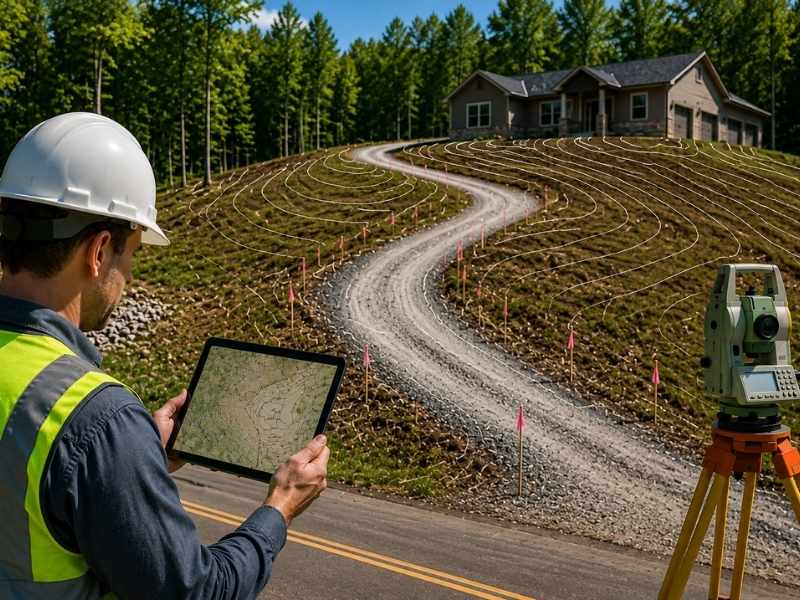
A topographic survey can save a property owner thousands of dollars before a single piece of equipment arrives on a rural sloped lot. Most people think of a topo survey as something engineers use. But for anyone planning a driveway on a lot outside city limits, the data it produces answers questions that no site visit or aerial photo can reliably answer.
How Topo Data Helps You Choose the Right Driveway Material
Driveway material selection on a sloped lot isn’t just a preference. It’s a decision driven by grades. A slope that works fine under gravel becomes a washout problem after heavy rain. A grade that’s manageable for asphalt becomes a safety issue in winter. A topo survey shows exactly how steep the driveway path is before any material gets ordered.
On rural lots, gravel is the most common starting point for new driveways. But gravel needs to stay put, and steep grades move it. A topo survey shows whether a proposed path stays within a safe range for loose material, or whether the slope requires a bound surface like asphalt or concrete. That decision, made before ordering begins, can shift the entire project budget. Getting it wrong after the fact means tearing out and replacing a surface that never should have gone in.
What Topo Survey Data Shows About the Driveway’s Road Connection Point
The spot where a driveway meets the road is one of the most important and most overlooked parts of driveway planning. On rural sloped lots, the road often sits at a different elevation than the lot. That grade change affects sight lines for drivers pulling out, the angle at which vehicles move from road to driveway, and whether stormwater drains toward or away from the road.
A topo survey captures the exact elevations at the road connection point. That data shows how much grade change happens in the first few feet of the driveway and whether water will sheet toward the road or drain back onto the property. A poorly graded connection point can trigger a required redesign after a permit review, or create a drainage conflict that the county road department flags during inspection.
How Soil Type Combined With Topo Data Affects Base Preparation Costs
Elevation data tells you how steep the land is. It doesn’t tell you what’s underneath. On sloped rural lots, soil type and topo data work together to determine how much base preparation a driveway needs. Base preparation is often the largest cost variable in the whole project.
A lot with clay-heavy soil and a moderate slope needs a much deeper gravel base than a well-drained lot at the same grade. Clay holds water. On a slope, water-saturated clay moves. A driveway placed over a weak base on a clay slope can shift and fail within a few seasons. Topo data combined with a basic soil check gives a contractor the information needed to spec the base correctly from the start. Without both, the contractor either pads the cost or cuts corners on depth.
Using Topo Survey Data to Choose the Lowest-Cost Driveway Alignment
The most direct path from the road to the house is rarely the cheapest one on a sloped rural lot. A straight-line route that cuts across steep grade changes often requires retaining walls or heavy fill to keep the surface at a drivable angle. Each of those adds cost that a different alignment might avoid.
A topo survey gives a property owner and their engineer multiple paths to compare before any commitment gets made. A route that follows a natural contour, even if it runs a little longer or curves slightly, often moves far less dirt than the obvious straight path. A route adjustment of 30 or 40 feet that follows the grade can sometimes eliminate a retaining wall that would have cost several thousand dollars on its own. Those decisions only happen when topo data exists to compare the options.
When Topo Data Reveals That a Driveway Permit May Require Engineering Review
On sloped rural lots, a topo survey sometimes uncovers grade percentages that trigger a required engineering review before a driveway permit gets issued. Most areas set a threshold around 10 to 12 percent slope for residential driveways. Above that, a standard permit application may not be enough.
Finding that out mid-construction is expensive. Work stops while an engineer gets hired and drawings get prepared. On a rural lot with a small contractor window, that delay can push the project into a different season. A topo survey done before the permit application reveals the grade numbers early. If the slope triggers a review requirement, the engineering work gets done upfront and folded into the original plan.
Frequently Asked Questions
Does a topographic survey show where a driveway should go?
A topo survey doesn’t pick a driveway location. It provides elevation and terrain data that makes it possible to evaluate which paths are practical, affordable, and safe. The property owner and their engineer use that data to make routing decisions.
How accurate does a topographic survey need to be for driveway planning?
For driveway construction on sloped lots, a one-foot contour interval is generally the minimum level of detail needed. Coarser intervals can miss grade changes that affect material selection, grading costs, and drainage planning.
Can a topographic survey help avoid retaining walls on a sloped driveway?
Yes. Topo data allows planners to find alignments that follow natural grade. A route adjustment of even 20 to 30 feet can sometimes eliminate the need for a retaining wall entirely.
What is the difference between a topographic survey and a grading plan?
A topographic survey documents existing land conditions. A grading plan uses that data to specify how the land will be changed. One describes what’s there. The other directs what gets modified.
Is a topographic survey required before building a driveway on a rural lot?
It’s not always legally required. But on sloped rural lots, unforeseen grading or slope issues found mid-project cost far more to fix than the survey itself.
How does topo survey data affect a driveway construction bid?
Without topo data, contractors build assumptions into their bids to protect themselves. With accurate elevation data, bids become more precise and change orders are less likely.